Please fill out the form to ask us machining questions.
Machining.Blog® is a weekly blog focused on manufacturing career development. It features blog articles on the fundamentals of manufacturing for aspiring machinists. Our goal is to create an interest in manufacturing in the USA. Our writer Matthew Schowalter has worked in manufacturing for 24 years, and he covers the topics that matter to someone starting their career in manufacturing.

“The soft skills the machinist uses are the unseen tools in their box and can directly impact the success or failure of a dreamed after machining career.”
All in CNC Programming
Please fill out the form to ask us machining questions.
Here is a great video about Cardinal Manufacturing which is a student-run business in the Eleva-Strum High School. It’s a manufacturing program in the technical education department where the students are responsible for all aspects of the business.
I recently had an opportunity to interview Phil Brown and Umair Riyas from NexGenCAM about how to begin a career in computer-aided manufacturing or CAM. They are applications engineers that specialize in CAM software. Phil and Umair have extensive backgrounds in CNC and CAM/CAD, they offer a few tips to others who may be interested in starting a career in the field.
The entire NexGenCAM team (over 35 people) will be there to answer questions about the design and manufacturing software that they support, which includes Autodesk software products. To register for the event, follow the link below that will take you to their website.
Cardinal Manufacturing is a student-run manufacturing program in the Eleva-Strum high school. They recently finished a 10-month remodeling project in the machine shop and classroom. It was a complete remodel which included the ceiling and walls being repainted. They chose a red and white color scheme for the rooms, halls, and manufacturing equipment.
Standard G-Codes for CNC Lathes
G0 - Rapid Movement
G1 - Linear Feed Movement
G2 - Clockwise Interpolation - Circular Movement
G3 - Counter Clockwise Interpolation - Circular Movement
G4 - Dwell
G9 - Exact Stop
G10 - Set Data
G17 - XY Machine Plane Selection
With my study into the shortage of skilled manufacturing workers that spanned five years, I discovered a few things along the way. The observations started in 2015 by investigating ways to spark interest in manufacturing careers. I published a 4-page article on my career, and it was promoted by three manufacturing magazines. I also assisted my local youth apprentice program by creating a testimonial video for them. I participated in a career fair and only 1% of the students were engaged in manufacturing. I then decided to observe the industry.
A ¼ scale locomotive named the Beef River Flyer operated in Strum Wisconsin from the mid 1960’s to the mid 1970’s. The eight-horsepower locomotive could pull up to 22 tons on a level track. It had four cars, with a maximum of 30 people riding in the cars. It was an attraction that drew in hundreds of riders per year.
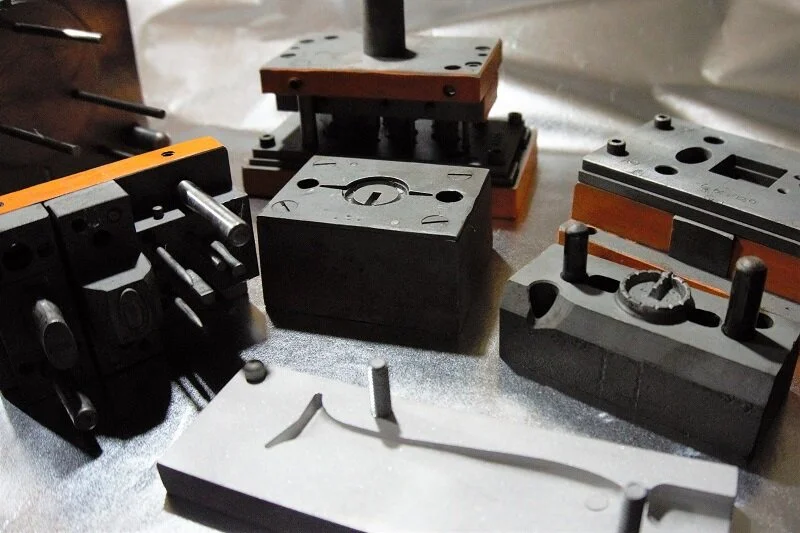
I started my career in tool and die making without having a grasp of what it actually was. Over the years, I have worked with many tool and die makers that said the same thing. I now explain it to people as a tool and die maker makes industrial tools which make parts. There are several main types of industrial tools, they are typically molds and stamping dies.
Do You Have the Important Qualities for a Career in Machining?
Do you have a mechanical skillset?
Are you a technical person?
Do you excel at math?
If so, consider a career as a Machinist or Tool and Die Maker
Mathematical Skills - Ability to add, subtract, multiply, divide, and compute basic trigonometry functions while choosing the right methods to solve the problem
Reasoning Ability - Ability to use common sense understanding and solve problems
Oral Comprehension - Ability to listen and understand information spoken
Computer Literacy - Ability to use a computer and work with Microsoft Office programs
Mechanical / Technical Skills - Must operate lathes, mills, grinders and other computer controlled machines
Machinists make components and parts on computer controlled manufacturing equipment such as a CNC lathe or a CNC mill.
Tool and die makers make tool, die and mold components and other industrial tools on manual and CNC equipment. They also fit the components together and align and assemble the industrial tools.
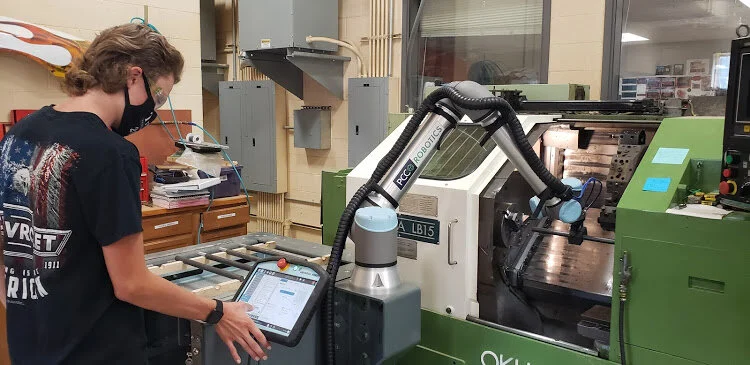
Tiger Manufacturing is a school based business in Webster High School in Webster Wisconsin. It is a business run inside the schools technical education program. The program is run by the teacher Roy Ward. I asked Roy a few questions about the program and the implementation of the cobot on the CNC lathe.
Cardinal Manufacturing in Strum Wisconsin is a school-based manufacturing program that operates both as a class and a business as well. The students gain real world life experiences while enrolled in the program. These experiences include problem solving and working in professional roles.