Cardinal Manufacturing in the Eleva-Strum School District in Wisconsin is a student-run manufacturing business that has repair services, welding services, woodworking services, machining services, design services, and 3D printing services.
Machining.Blog® is a weekly blog focused on manufacturing career development. It features blog articles on the fundamentals of manufacturing for aspiring machinists. Our goal is to create an interest in manufacturing in the USA. Our writer Matthew Schowalter has worked in manufacturing for 24 years, and he covers the topics that matter to someone starting their career in manufacturing.
“The soft skills the machinist uses are the unseen tools in their box and can directly impact the success or failure of a dreamed after machining career.”
All in Soft Skills
Cardinal Manufacturing in the Eleva-Strum School District in Wisconsin is a student-run manufacturing business that has repair services, welding services, woodworking services, machining services, design services, and 3D printing services.
Machining is by far more interesting than what most people know. From the challenges of implementing new complex equipment in the shop, to CNC programming, or even making complex parts in one setup. It is definitely a career choice that most don’t know how advanced it can be, especially the machining of today. Now, we can make parts in one setup that were once made in many setups on multiple pieces of equipment over a long time frame. My career is a success story in manufacturing technology as I have embraced the technology of today.
The shop floor hums before the sun is fully up. The air carries a faint scent of machine oil, and the rhythmic clatter of metal on metal is already underway. For a precision machinist, the day doesn’t just begin with a clock-in, it begins with a mindset: accuracy above all else.
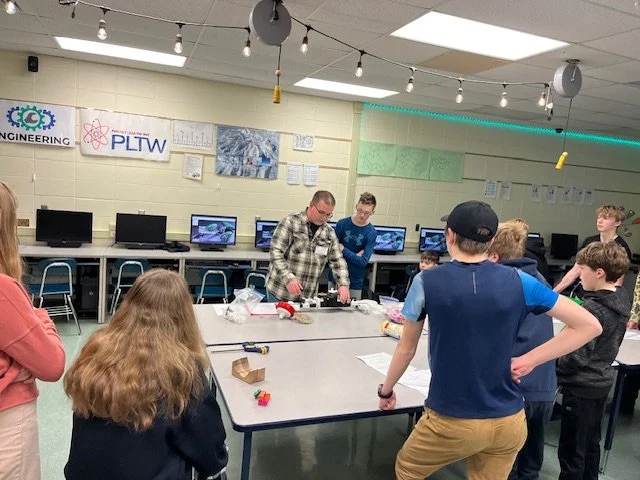
I gave a classroom presentation in two engineering classes within the technical education department at a local middle school. The students were engaged in the mechanical clock presentation and asked me great questions.
Across the country, educators are searching for meaningful ways to prepare students for life after high school. At Cardinal Manufacturing in Strum, Wisconsin, that preparation is at the core of their mission. The program’s primary goal is to equip students with the technical skills, confidence, and strong work habits that employers look for, such as professionalism, communication and responsibility.
I recently had an opportunity to work with the technical education program at Eleva-Strum School District in Wisconsin. The project that I had for the students was to modify a few parts for a mechanical clock. It was an amazing experience to be greeted at the door by a student and the student gave me a great handshake. The technical education class teaches these soft skills to the students, starting in seventh grade.
Cardinal Manufacturing in Strum Wisconsin is a school-based manufacturing program that operates both as a class and a business as well. The students gain real world life experiences while enrolled in the program. These experiences include problem solving and working in professional roles.
Cardinal Manufacturing is a student-run business in the Eleva-Strum High School. In a student-run business the students are responsible for all aspects of the business. It is a custom job shop that makes machined parts for community members and people throughout the country. Check out this video on the program.
Nestled in Eleva-Strum High School, Cardinal Manufacturing is revolutionizing technical education through its student-run business model. As a beacon of excellence, Cardinal Manufacturing in Strum, Wisconsin empowers students to gain hands-on experience in manufacturing while running a real business. This innovative approach not only equips students with invaluable skills but also positions the program as a leader in the technical education world.
The community support of the technical education program at Eleva Strum High School is impressively large and there are several reasons why. The technical education program operates as a student-run business that fabricates and machines parts for customers. The business is called Cardinal Manufacturing. The money made by the business is used to buy raw materials, upgrade equipment, marketing, cover the operating costs, and to pay the student employees.
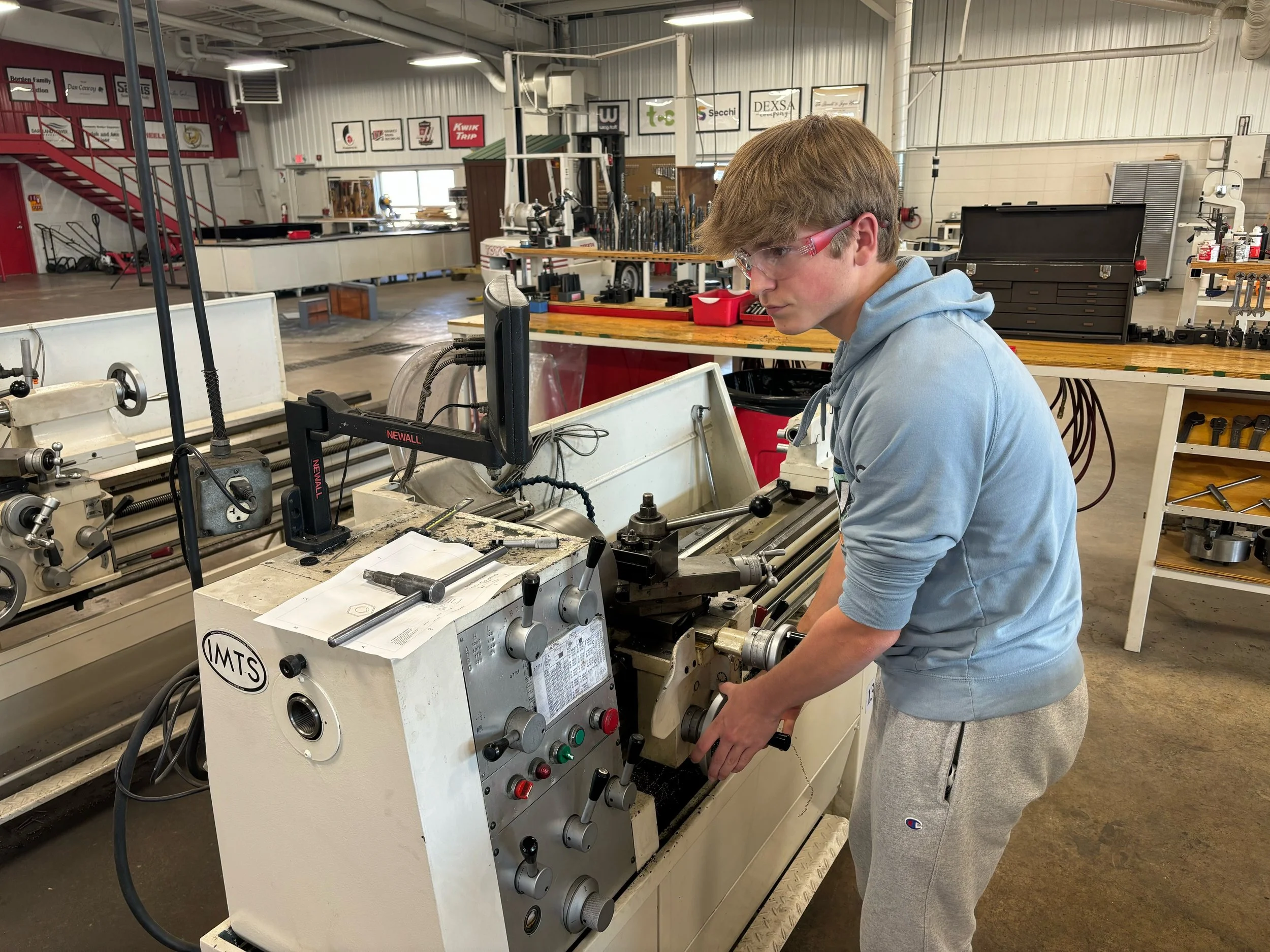
I recently had an opportunity to visit the technical education department at the Eleva-Strum high school. While I was in the shop, there was an eighth-grade class working on manual milling projects, sheet metal projects, welding projects, and brazing projects. These projects that they were making teach the students the fundamental principles of manufacturing. With this class, the students spend six days in each subject area, then they switch to another project. They learn the basics like how to read a tape measure, and how to use a dial caliper.
Over the last 5 years, I have been observing the manufacturing industry worker shortage. The drastic change that I have seen over my 24-year career is alarming. While most industries change over time, I believe the changes that are happening to manufacturing are more than that. We are in a worker shortage crisis.
While recently attending a workshop on starting or growing your school-based enterprise at the school district of Eleva-Strum in Wisconsin I discovered that they have great model for their student-run business. Their program, Cardinal Manufacturing teaches soft skills and employability skills along with learning the technology.
Here is a great video about Cardinal Manufacturing which is a student-run business in the Eleva-Strum High School. It’s a manufacturing program in the technical education department where the students are responsible for all aspects of the business.
Cardinal Manufacturing is a student-run manufacturing program in the Eleva-Strum high school. They recently finished a 10-month remodeling project in the machine shop and classroom. It was a complete remodel which included the ceiling and walls being repainted. They chose a red and white color scheme for the rooms, halls, and manufacturing equipment.